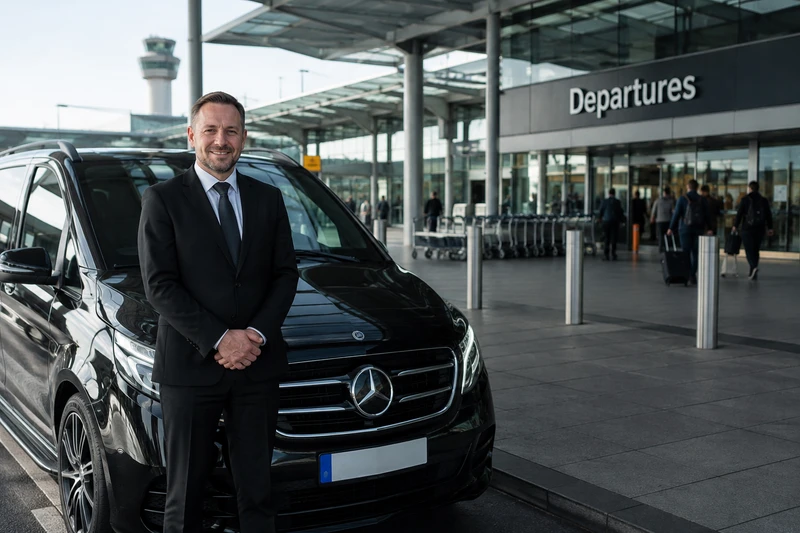
A Liverpool to Gatwick transfer covers one of the longer routes Neves JR runs, close to 235 miles and just over four hours once traffic past Birmingham and around the M25 is factored in.
Neves JR provides this Liverpool to Gatwick chauffeur service for passengers flying with airlines based specifically at Gatwick, easyJet, Emirates and Qatar Airways among them, rather than assuming every southern flight goes through Heathrow. Gatwick also splits its traffic across two terminals, North and South, which matters more here than the airport code on a boarding pass suggests.
Gatwick Is a Different Airport From Heathrow, and the Route Reflects It
Liverpool sits north-west, Gatwick sits south of London, and the drive between them runs the length of the country: roughly 235 miles, usually via the M62 onto the M6, then the M40 and M25 before dropping south on the M23.
Under ordinary traffic that's around four hours; add a Friday evening or roadworks near Birmingham and it stretches further.
The airlines matter as much as the distance. Emirates and Qatar Airways run long-haul services from Gatwick that Manchester doesn't always carry, and easyJet, Ryanair, Wizz Air and TUI split a large share of Gatwick's short-haul and holiday routes between them.
A passenger booked on one of those isn't choosing Gatwick over Heathrow at random, and a Liverpool to Gatwick chauffeur booking reflects that.
Gatwick also runs from a single runway, unusual for an airport handling this volume of long-haul and short-haul traffic at once. It moves aircraft on a tight schedule, and a delay early in the day ripples through the rest of it more than it would with a second runway to fall back on.
Terminal | Main airlines | Note |
North Terminal | easyJet, Emirates, Qatar Airways, SWISS | Larger terminal by passenger volume |
South Terminal | British Airways, Ryanair, Wizz Air, Vueling, Turkish Airlines | Train station sits beside this terminal |
A free shuttle connects the two terminals in about two minutes, running around the clock. It solves the walk between them. Getting the terminal wrong before setting off from Liverpool costs more than the shuttle ride itself; it costs the certainty of knowing exactly where the car should stop on arrival. A Liverpool Gatwick transfer confirmed to the right terminal in advance removes that risk entirely.
Does the Train Beat Driving From Liverpool to Gatwick?
Not for most of the people booking this route, and the reasoning is straightforward rather than a matter of taste.
The train runs Liverpool Lime Street to London Euston, then a separate service from Victoria to Gatwick, at roughly three hours of scheduled travel time.
That figure doesn't include the change across London between Euston and Victoria, on foot or by Underground, with luggage.
Add that crossing, plus the usual station buffers, and the practical door-to-door time closes in on what a Liverpool to Gatwick chauffeur transfer takes anyway, minus the certainty of a single vehicle the whole way.
Light luggage and a flexible schedule make the train a reasonable choice. A group, a flight with a fixed check-in deadline, or bags that don't fit easily through a station change tip it the other way.
Neves JR is built for the second case, and most bookings on this route fall into it.
Who Flies From Gatwick, and Why It's Rarely a Manchester Substitute
Business travellers connecting onto Emirates or Qatar Airways long-haul services account for a steady share of bookings, since those routes aren't duplicated at every UK airport and Gatwick carries more of them than Manchester does.
Families and groups on easyJet, Ryanair, Wizz Air or TUI holiday routes make up the largest share by volume, often travelling with more luggage than a single car boot comfortably holds and appreciating the V-Class for exactly that reason. School holiday periods push demand for this particular route higher than the rest of the year.
Corporate clients occasionally book a Liverpool to Gatwick transfer for a single travelling executive on a fixed schedule tied to one specific flight, and the S-Class suits that kind of trip better than the larger vehicle built for groups and luggage.
How a Liverpool to Gatwick Transfer Gets Arranged
Bookings start with the flight number and airline, which settles the terminal question before the car leaves Liverpool. Passenger count and luggage volume decide the vehicle, and the pickup time works backwards from the four-hour drive plus the airport's own check-in buffer.
The assigned driver tracks the outbound flight for schedule changes and the inbound one for the return leg. A delayed arrival shifts the collection time; it doesn't leave the client stranded at the wrong terminal wondering where the car has gone.
Coverage runs nationwide from Liverpool and the wider North West, and a Liverpool to Gatwick transfer gets booked often enough on this route that Neves JR treats it as a standard journey, not a one-off exception planned from scratch each time.
FAQ
1. How far is Liverpool from Gatwick Airport by road?
Around 235 miles, usually via the M6, the M40, the M25 and then the M23. Under normal traffic the drive takes about four hours.
2. Which Gatwick terminal does a Liverpool passenger need, North or South?
It depends on the airline. easyJet, Emirates, Qatar Airways and SWISS use North Terminal; British Airways, Ryanair, Wizz Air, Vueling and Turkish Airlines use South, where the train station is also located.
3. Is the train from Liverpool to Gatwick faster than a chauffeur transfer?
The scheduled train time is around three hours, but that excludes the change between Euston and Victoria stations in London. With that change added, the total is close to the driving time.
4. What happens if a return flight from Gatwick is delayed?
The driver tracks the flight and adjusts the collection time accordingly. The booking isn't tied to the original scheduled arrival time.
5. Can a group with heavy luggage book a Liverpool to Gatwick transfer?
Yes. Luggage volume and passenger count are confirmed at booking, and larger groups are placed in the V-Class rather than split across separate cars.
Continue reading